This past Memorial Day weekend, we visited a church that we'd visited before, but had since moved into what is now it's "permanent location." As we went there, the first Hymn we sang was the Battle Hymn of the Republic. I'd read this article before and found that I could not sing all of the verses.
I've thought about this article long and hard since I read it more than 6 months ago: "Honest Abe" has always been a larger than life figure. How much of the legend about Lincoln is true?
Let's look at what is true:
I've thought about this article long and hard since I read it more than 6 months ago: "Honest Abe" has always been a larger than life figure. How much of the legend about Lincoln is true?
Let's look at what is true:
- Slavery is an abhorrent practice that lasted in the civilized world until the mid to late 1800s (although it is still practiced in Africa),
- The Crux of the Old Testament is that the LORD GOD brought his people, Israel out of slavery. We are reminded so with the words that begin the 10 commandments: I am the LORD, Your GOD, who brought you out of Egypt, and the land of slavery (Exodus 20:2). The LORD GOD instituted "the Sabbath Day". as a day of rest, where Man would not work and reflect and rely on GOD. GOD provided food from Manna for the children of Israel in their journey through the Wilderness and up to the time Moses received the 10 commandments on Mount Horeb, until Moses had died and Joshua and Caleb followed the lead of the Lord GOD into the promised land. Later, when Israel settled the land, the"Sabbath Year" was instituted, where the fields of Israel were to be given and a rest and lay fallow, and Israel would rely on the Grace of GOD through the harvest of the previous year for enough food to carry the nation through The Year of Jubilee," where all debts were to be forgiven and land would revert back to its original owners.
- While the practice of indentured servitude (where you could sell yourself into slavery or service to another to buy what you could never afford - e.g. a passage by ship to America from England), was accepted until the 1700s and 1800s, there was little difference between that practice and slavery.
- Debt is slavery. But the forgiveness (emancipation) of slavery is as close to divinity as it is possible for man to get.
- The state of Georgia was founded, with Savannah as a debtor's prison colony.
But times were changing, with the founding of the United States. The movement of the Abolition of Slavery was starting and gaining strength. And while most people think that the War Between the States was fought to end slavery and Abraham Lincoln ended slavery with his "Emancipation Proclaimation," these were tertiary issues that most citizens of the United States didn't care for and were only "added" to the "Reasons for the War" when it was assured that the North would win it. Rightfully, Americans had the guts to say that slavery was a moral evil. However the War Between the States was fought over far more than slavery.
The Constitution of the United States decreed that states could secede from the Untied States. Yet, Abraham Lincoln decided that the Union of States was more important than the Constitutional right of the states to leave that union. Many soldiers, including Southern General Robert E. Lee, a General with distinguished service in the Mexican and American War, resigned his commission in the United States Army, to defend his home state of Virginia, against what he saw as Federal Government overreach against his state.
Many (probably most) Southerners weren't slave owners (Robert E. Lee, did not own slaves, although his Father-In-Law bequeathed his slaves to Marse Robert and his daughter. Lee freed these slaves). The closer you got to the mountains, the more there were dirt poor farmers, trying to eek out a living, hunting and farming on their land to support their family. These people couldn't afford slaves. Yet, Northerners have broadly painted all Southerners as slave owners and, therefore racists, who are less than human.
Most Northerners didn't give a happy damn that the Southerners seceded from the Union, as evidenced by the Conscription Riots. But, that's not the way the story is told, truth be damned.
The Abolition of Slavery didn't become a real issue, until after the Union Army routed the Confederate Army at Gettysburg, the turning point of the war. Lincoln then gave his Gettysburg Address and his Emancipation Proclaimation (Freeing only Southern Slaves - Yes, gentle reader, there were still slaves in the Union, despite what history revisionists would have you believe).
And as I said before in this blog post, to the winner of the war go the spoils, including the right to revise history to tell the winner's story. So, Lincoln was dieified, made into something more than a simple backwoods politician. The 'Just Cause,' for which he championed and compelled others to fight (after the Union victory at Gettysburg) had little to nothing to do with the issue of slavery and more to make his legendary status powerful and without stain. Because if the South had won or Lincoln had let them walk away, the United States, at least 1/2 of his power base would have left, leaving him as the leader of a small country, not 100 years old at that time. And old Abe, was made into a "savior" of sorts with his ending of slavery (that wouldn't occur until after the end of the war with the surrender of Lee to Grant at Appomattox).
So, seeing the "Battle Hymn of the Republic" in a new light, and its attempt at the deification of Lincoln, I could not in good conscience sing some of the verses, with the "biblical imagery." I didn't sing and prostate myself before another "god," created by man. I tried to be respectful and just stayed quiet during some of the verses with which I could not agree.
Having said all of this, I present you with Ludwell H. Johnson's article In Search of the Real Abe Lincoln. I invite you to read the article, do the research into history and decide whether Lincoln was a man on a righteous mission, or just a man, who understood politics and made a political decision. Look at the man: Notice his "feet of clay." Is he really a diety, a man who has transcended into "god" by taking up a righteous cause or an opportunist, who was "made into a diety' to excuse the attacks on Southerners that today would warrant war crimes tribunals and judgement of whether what soldiers did in the name of a just war was just an excuse and cover-up?
The Constitution of the United States decreed that states could secede from the Untied States. Yet, Abraham Lincoln decided that the Union of States was more important than the Constitutional right of the states to leave that union. Many soldiers, including Southern General Robert E. Lee, a General with distinguished service in the Mexican and American War, resigned his commission in the United States Army, to defend his home state of Virginia, against what he saw as Federal Government overreach against his state.
Many (probably most) Southerners weren't slave owners (Robert E. Lee, did not own slaves, although his Father-In-Law bequeathed his slaves to Marse Robert and his daughter. Lee freed these slaves). The closer you got to the mountains, the more there were dirt poor farmers, trying to eek out a living, hunting and farming on their land to support their family. These people couldn't afford slaves. Yet, Northerners have broadly painted all Southerners as slave owners and, therefore racists, who are less than human.
Most Northerners didn't give a happy damn that the Southerners seceded from the Union, as evidenced by the Conscription Riots. But, that's not the way the story is told, truth be damned.
The Abolition of Slavery didn't become a real issue, until after the Union Army routed the Confederate Army at Gettysburg, the turning point of the war. Lincoln then gave his Gettysburg Address and his Emancipation Proclaimation (Freeing only Southern Slaves - Yes, gentle reader, there were still slaves in the Union, despite what history revisionists would have you believe).
And as I said before in this blog post, to the winner of the war go the spoils, including the right to revise history to tell the winner's story. So, Lincoln was dieified, made into something more than a simple backwoods politician. The 'Just Cause,' for which he championed and compelled others to fight (after the Union victory at Gettysburg) had little to nothing to do with the issue of slavery and more to make his legendary status powerful and without stain. Because if the South had won or Lincoln had let them walk away, the United States, at least 1/2 of his power base would have left, leaving him as the leader of a small country, not 100 years old at that time. And old Abe, was made into a "savior" of sorts with his ending of slavery (that wouldn't occur until after the end of the war with the surrender of Lee to Grant at Appomattox).
So, seeing the "Battle Hymn of the Republic" in a new light, and its attempt at the deification of Lincoln, I could not in good conscience sing some of the verses, with the "biblical imagery." I didn't sing and prostate myself before another "god," created by man. I tried to be respectful and just stayed quiet during some of the verses with which I could not agree.
Having said all of this, I present you with Ludwell H. Johnson's article In Search of the Real Abe Lincoln. I invite you to read the article, do the research into history and decide whether Lincoln was a man on a righteous mission, or just a man, who understood politics and made a political decision. Look at the man: Notice his "feet of clay." Is he really a diety, a man who has transcended into "god" by taking up a righteous cause or an opportunist, who was "made into a diety' to excuse the attacks on Southerners that today would warrant war crimes tribunals and judgement of whether what soldiers did in the name of a just war was just an excuse and cover-up?
In Search of the Real Abe Lincoln
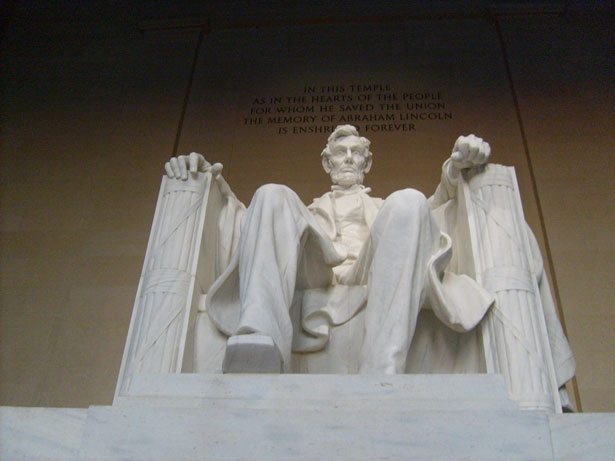
No one interested in American history can escape Abraham Lincoln. Over the years the outpouring of books, articles, essays, and poems has been enormous, so much so that this form of activity is sometimes referred to as “the Lincoln industry.” With all of this attention devoted to one man, how can there be a “Lincoln puzzle”? Surely all Americans know him — walking for miles to borrow (or return) books, reading by firelight, splitting fence rails, wrestling with the boys (always winning) — this simple, rugged, honest son of the frontier, a man of the people, called by them to save the Union and free the slaves, presiding with melancholy anguish over a long and bloody war, comforting Mrs. Bixby for the loss of her sons. Is this not what they see when they go to the Lincoln Memorial and look up at that brooding giant whose somber gaze seems to penetrate the very meaning of life? Where is the puzzle?
What Americans see is the legendary Lincoln, who began to take shape when he was assassinated by John Wilkes Booth on Good Friday. The legend-making that followed must be understood within the context of the religious currents of the day, in particular millennialism. This was the belief, then pervading much of American Protestantism, that the Revelation of St. John the Divine was about to be fulfilled. The promised battle against Satan was at hand, and when Satan was bound there would begin the thousand years’ kingdom of God on earth, followed by the Second Coming of Christ and the Final Judgement. From the time of the settlement of New England, prominent divines such as Jonathan Edwards had connected the coming of the millennium with the founding of the colonies and had identified Americans as the Chosen People of God and America as the place where the millennium would begin. But the way for this great event had to be prepared by purifying society. This meant battling Satan, whose principal manifestation, to northern Protestants, was the slaveholding South.
So when the war came it was seen as nothing less than Armageddon. The favorite war song of the North, Julia Ward Howe’s “Battle Hymn of the Republic,” was filled with images from Revelation. Union armies marched south to “trample out the vintage where the grapes of wrath are stored” (Rev. 14:19-20). The events of the war were often described as the enactment of John’s prophecies. When Richmond fell, a leading religious paper said: “Who can ever forget the day? Pentecost fell upon Wall Street, till the bewildered inhabitants suddenly spake in unknown tongues — singing the doxology to the tune of ‘Old Hundred!’ …The city of Richmond [had fallen], Babylon the Great, Mother of Harlots and Abominations of the Earth….Rejoice over her thou, Heavens.” And so on it went. (The reader may refer to Rev. 17:5; 18:20-21.)
This, then, was the atmosphere when at the moment of his final triumph, the leader in this war against “the Beast” was struck down —on Good Friday. Two days later, on what was called “Black Easter,” from pulpit after pulpit the life and death of Abraham Lincoln were assimilated to Christian eschatology.
Here was created an important component of the legendary Lincoln. For many, Lincoln became a symbolic Christ, for some, perhaps, more than symbolic. They could scarcely help themselves, the parallels were so striking. He was the savior of the Union, God’s chosen instrument for bringing the millennium to suffering humanity, born in a log cabin (close enough to a stable), son of a carpenter. (Later on, incidentally, there were those who believed that such an ordinary man as Thomas Lincoln could not have fathered such a son, that there was a mystery about Lincoln’s paternity.) He was a railsplitter (close enough to carpentry), a humble man with the human touch, a man of sorrows and acquainted with grief, called by his followers to supreme greatness, struck down by Satan’s minions on Good Friday. Said one minister in his Black Easter sermon, “It is no blasphemy against the Son of God and the Saviour of Men that we declare the fitness of the slaying of the second Father of our Republic on the anniversary of the day on which he was slain. Jesus Christ died for the world, Abraham Lincoln died for his country….The last and costliest offering which God demanded has been taken.” Another spoke of his “mighty sacrifice ….for the sins of his people.” Yet another proposed that not April 15, but Good Friday be considered the anniversary of Lincoln’s death. “We should make it a movable fast and ever keep it beside the cross and grave of our blessed Lord, in whose service and for whose gospel he became a victim and a martyr.” For years after the war the rumor persisted that Lincoln’s tomb in Springfield was empty. Lincoln was also frequently compared to Moses, who led his people to the Promised Land that he was not allowed to enter, and, like Moses after viewing Canaan, was taken by death.
The preachers did have one awkward problem: the martyred president had been shot while in a theater. To the pious of those days a theater was little better than a bawdy house. What was the chosen of God doing in a place like that on Good Friday? Of all the tortured explanations and fabrications, perhaps a Springfield Baptist minister came up with the best. He testified that Mrs. Lincoln herself had told him that her husband “paid little or no attention to the actors on the stage that night. Instead, he talked with his wife about his future plans. He wanted to visit the Holy Land to see the places hallowed by the footsteps of the Saviour. ‘He was saying there was no city he so much desired to see as Jerusalem; and with that word half spoken on his tongue, the bullet of the assassin entered his brain.’ ” As historian David Donald has pointed out, Lincoln was saved from complete deification by the American love for folk heroes, and so he developed into a combination of Paul Bunyan, Mike Fink, and Jesus,
A homely hero born of star and sod,
A peasant prince, a masterpiece of God.
A peasant prince, a masterpiece of God.
This towering yet intensely American character quickly became, and was fashioned into, hot political property for the Republican Party, which (during his lifetime) had by no means been composed entirely of Lincoln fans. Now dead and safely out of the way, the martyr was a tremendous asset at election time. For many years he was a Republican monopoly. Then the Democrats tried to muscle in. It was one of the “mysteries of Providence,” said Woodrow Wilson, that the Republican Party he knew should have sprung from Lincoln. And in the election of 1928 the Democrats touched the outer limits of incongruity when they bracketed Abraham Lincoln with Al Smith. The tussle for possession of the Great Emancipator continued until Franklin D. Roosevelt finally broke the corner on Lincoln stock amidst outraged protests from Republicans.
Before Lincoln’s dramatic death there had, in fact, been many Americans who had a low opinion of the man from Illinois. He received a shade under 40 percent of the popular vote in 1860, and in 1864, when the South was out of the Union and not voting, 45 percent of the electorate picked McClellan over Lincoln. He was attacked viciously by members of his own party. “The original gorilla,” Edwin Stanton called him before he accepted Lincoln’s offer of the War Department. “A first-rate second-rate man,” sneered abolitionist Wendell Phillips, and there were many more.
Although the tide turned after the assassination, even then not everyone saw him as a demigod from the prairies. One might, of course, expect something less than wholehearted praise from the devastated South. When news of the assassination reached occupied Richmond, the Union general in command ordered all city churches to hold services of prayer and lamentation. One Methodist minister arrived at his church on the appointed day, found a handful of people there, ascended the pulpit and said: “My friends, we have been ordered to meet here, by those in authority, for humiliation and prayer on account of the death of Lincoln. Having met, we will now be dismissed with the doxology, ‘Praise God from whom all blessings flow.’ ”
Even in the North there was by no means unanimous acceptance of the nascent legend. People who had known and loved him could not swallow the unfamiliar Lincoln they saw springing up before their eyes. Chief among these was a man who would have a lasting influence on Lincoln scholarship, William H. Herndon, Lincoln’s law partner for sixteen years before the war. He believed that his friend’s true stature was best measured in the light of the whole truth, and he abominated what he saw as the sickly sentimental prettification of the man he had known so intimately. Herndon’s own recollections plus those of others he assiduously collected were the beginning of the search for the real Lincoln. His efforts were attacked ferociously by the guardians of the legend. The battle was on, and it has continued to this day.
The points of controversy include Lincoln’s personality and character as well as his actions. His religious beliefs have always attracted interest. Was he a believer or a scoffer? If the former, did he accept Christ or was he a deist? How did the spiritualist seances held in the White House fit in with his religion? Men of the cloth agonized over such questions. They also engaged in an unseemly struggle to claim the president for their respective denominations.
Was Ann Rutledge the love of Lincoln’s life? And did her death plunge him into one of history’s most renowned cases of melancholy? Or was Lincoln depressed because he suffered from chronic constipation, as one of his law partners believed? Was his home life with Mary Todd at least reasonably satisfactory, or was it a living hell? Did he tell off-color jokes because he was at heart a frontier vulgarian, or did he use laughter to soothe a sensitive and suffering soul?
Was he really a humble man even in the White House, he of the shawl and carpet slippers, or was he a cold and calculating manipulator of men, moving them about as remotely as he would pieces on a chessboard, driven by a quenchless ambition, a “little engine that never stopped”? Did he knowingly provoke hostilities at Fort Sumter, bringing down upon the country a dreadful war that left 650,000 dead and half the country in ruins? Or was war thrust upon him by Southern hotheads at Charleston? Was he a principled statesman, or was he a politician who operated according to the rule that what was good for his party was good for the country? Was he a strong president who steadfastly guided the nation through its darkest night, or was he content merely to float with the political tide? Was he a commander-in-chief who demonstrated his military genius by leading the North to victory, or was he a politically motivated meddler who spoiled the plans of professional soldiers and so prolonged a bloody war? The list of controversies could be extended indefinitely.
All of these questions are difficult, and the scholars seem little closer to definitive answers than were those who knew Lincoln personally. In recent years, however, a new tool has been employed, one that some believed would at last solve the enigma of Abraham Lincoln. This new technique is called psychohistory; its practitioners apply psychoanalytic methods to those who have crossed the Great Divide, confident that their true motive may at last be discovered. Not everyone, it must be said, has unlimited confidence in the results. Having seen batteries of skilled psychiatrists disagree in open court as to whether the accused is sane or looney, skeptics wonder about the reliability of such methods when directed at someone who has been dead for a considerable number of years. However, it is perhaps only fair to give a couple of examples of what psychohistorians have revealed about Lincoln.
One presents the following thesis: The America of Lincoln’s youth was like a big family that venerated the memory of the Founding Fathers, who had established and bequeathed to Lincoln’s generation a great nation. How did Lincoln regard these giants? In a speech given in 1838, Lincoln revealed inner conflicts, Oedipal in nature, consisting of an unconscious jealousy of the Fathers he consciously venerated. This jealousy was unacceptable; to resolve the ensuing conflict, he projected his feelings onto a “bad son” (Senator Stephen A. Douglas) whose policies threatened the Union, that priceless gift of the Fathers. So Lincoln defeated the bad son, but fulfilled the Oedipal dream by achieving an even more illustrious immortality. The war completed Lincoln’s dream by destroying the old nation of the Fathers and erecting a modern nation of which he was the Father.
Another psychobiographer’s venture makes much of an incident that Lincoln mentioned in a brief autobiography he wrote in 1860. Recalling his childhood, Lincoln said, “A few days before the completion of his eighth year, in the absence of his father, a flock of wild turkeys approached the log-cabin, and A. with a rifle gun standing inside, shot through a crack, and killed one of them. He has never since pulled trigger on larger game.” He then goes on to tell of his mother’s death, his father’s remarriage, and so forth. Believe it or not, this simple incident is fraught with hidden meaning. “Such a juxtaposition of memories suggests an association between the wild turkey and his dead mother. Both are helpless and both die.” Lincoln’s statement that he never again fired on “larger game” becomes “deep remorse,” that is, guilt not because he killed the turkey, but because of his infantile sexual longings for his mother, whom he wished to possess. He killed the turkey (a rather suitable stand-in for Thomas Lincoln), and his mother also died. This was the punishment for young Abe’s forbidden love. One can only wonder what Lincoln’s reaction would have been to this excursion into his psyche. Probably it would have reminded him of a little story.
The failure of scholars to reach a generally accepted synthesis of the real Lincoln has led to an irreverent suggestion, probably facetious, that it may be well to go back and take the Black Easter sermons as a point of departure, especially the ones that saw so many extraordinary parallels between the lives of Lincoln and Jesus. This is the hypothesis: A few years ago, a medical doctor at a West Coast university concluded that Lincoln had suffered from a genetic disorder called Marfan’s syndrome. The characteristics of this condition include a long, lanky, spiderlike frame and other physical traits associated with the president. Other effects are cardiac and circulatory failure, a feeling of coldness, a heavy pulse in the legs, and so forth, all of which are said to have afflicted Lincoln during the last months of his life. Melancholia is also typical of the syndrome.
The diagnosis is in itself intriguing, but (so this theory runs) it takes on a much greater, even a cosmic significance when juxtaposed with two other discoveries. First, a medical expert who has examined the famous shroud of Turin concluded the bodily type imprinted thereon, plus evidence related to the crucifixion, showed that Jesus also suffered from Marfan’s syndrome. Second, in their book Holy Blood, Holy Grail, Michael Baigent, Richard Leigh, and Henry Lincoln(!) claim that the bloodline of Jesus, through the children he is said to have had by Mary Magdalene, has been preserved into modern times. If one assumes that Lincoln was a lineal descendant of Jesus, says the originator of this theory, no wonder it has been so hard to understand him. Perhaps he can be known only by faith, not research. Should scholars, even psychohistorians, rush in where angels fear to tread?
Needless to say, the legendary Lincoln has been as impervious to such lampooning as Mount Rushmore to a peashooter. Yet there has been one question about Lincoln that has in recent years come closer to tarnishing his fame than anything else. This is his position on the race question. The reason is obvious. Lincoln had promised a new birth of freedom, but as the civil rights movement gained momentum after the Second World War, it was obvious that the descendants of the slaves freed so long ago were still at the bottom of the heap. Inevitably there was renewed scrutiny of the words and deeds of the Great Emancipator in hope of finding guidance and inspiration.
What then was found, or rather rediscovered? Although Lincoln was opposed to slavery, he was also opposed, as he told the voters in the 185O’s to social and political equality for blacks, whom he wished to colonize somewhere outside the country. There was no room for interpretation; his language was explicit. “There is a natural disgust in the minds of nearly ail white people, to the idea of an indiscriminate amalgamation of the white and black races.” “Make them politically and socially our equals? My own feelings will not admit of this.” “I will say then that I am not, nor ever have been in favor of bringing about in any way the social and political equality of the white and black races — that I am not nor ever have been in favor of making voters or jurors of negroes, nor of qualifying them to hold office, nor to intermarry with white people; and I will say in addition to this that there is a physical difference between the white and black races which I believe will for ever forbid the two races living together on terms of social and political equality. And inasmuch as they cannot so live, while they do remain together there must be the position of superior and inferior, and I as much as any other man am in favor of having the superior position assigned to the white race.” And as for colonization: “Let us be brought to believe it is morally right, and, at the same time, favorable to, or, at least, not against, our interest, to transfer the African to his native clime, and we shall find a way to do it, however great the task may be.” In the very midst of the war, he told a delegation of blacks who came to see him in the White House that “we have between us a broader difference than exists between almost any other two races. Whether it is right or wrong I need not discuss, but this physical difference is a great disadvantage to us both, as I think your race suffer very greatly, many of them by living among us, while ours suffer from your presence.” He urged them to lead their people out of the country. There would have been no war, he said, had you not been among us.
None of this was new, of course, but the context was new. Attitudes that were commonplace in the 1850s were taboo in the 1950s, and there ensued much discussion of Lincoln and the race question. At one extreme, some blacks accused Lincoln of being just another “honkie.” At the other, his defenders hastened to explain away his apparently racist sentiments and policies. It must be said that Lincoln’s admirers have not handled this delicate subject with nearly as much adroitness as the man himself. The explanation most of them rely upon is that he did not really believe all those unfortunate things he said; he was merely bowing to political necessities, all the while keeping his eyes fixed on a future when there would be true equality between blacks and whites. To pursue this ultimate goal he had to get elected; to get elected he had to come out forthrightly for white supremacy. Others believe that even if Lincoln was less than enlightened at one time, nevertheless he “grew” during the war, moving ever closer to the equalitarian ideals of today. For evidence they point to his last public address, in which he regretted that the new Unionist constitution of occupied Louisiana had not given the vote to those blacks who were “very intelligent” or who had served in the Union army, although he was pleased by Louisiana’s establishment of public schools for blacks as well as for whites.
To many people this did not seem like much “growth.” Unfortunately there is no evidence that he went any further. His desire to do so has to be taken on faith based on the conviction that whatever Lincoln did, his motives simply must have been impeccable. Lack of new evidence inevitably makes the arguments quite repetitious. Despite great ingenuity and, it must be said, occasional tampering with the facts, we are not any further along in reading Lincoln’s mind about race or anything else than we were thirty years ago.
To the writer, the most interesting aspect of the Lincoln puzzle is not what his real motives were, since we can never know that, but why they matter so much to so many people. Is it that the purity of Lincoln’s motives is indispensable to a belief in the righteousness of the Union cause? And if so, why then is it so important to believe that the cause of the Union was righteous? Is it that Americans wish their country, which many think was wrong in its last military crusade, to have been right in this one, which marked the beginning of modern America—their America? If Lincoln was not an equalitarian and the cause of the Union not particularly righteous, if the mystic chords of memory to which Lincoln appealed in his first inaugural resound to nothing more than politics as usual, do we lose our sense of identity as a nation? Do we lose our sense of mission, the belief — Lincoln’s belief — that the American way is the last best hope of mankind? And if we do, what then? Perhaps that is the real puzzle.
This article was originally published in the 1987 Summer Issue of Southern Partisan magazine